
Both my father (Michael Lucas) and I (Andrew Lucas) began our Great War research with genealogy, like so many of us who enter the field other than by the formal academic and military routes. Most obviously, dad's interest in his 'great-uncle Charlie' and his service with the 9th East Surreys was the seed which eventually bloomed into The Journey's End Battalion, in turn giving rise to his subsequent books related to the unit. He has covered some of our other family stories from the British side in various articles listed on our bibliography page. For my own part I started with my great-grandfather Arno Bierast but had branched out into the study of the Royal Saxon Army as a whole long before I ever thought of writing for publication.
This article is an attempt to do at least a little justice to the memory of all of our relatives, British and German alike, who are known to have served in 1914-1918.
British
My great-grandfather (dad's maternal grandfather) Private Charles PLOMER was born in 1898. Although his father and grandfather were engineers in Portsmouth Dockyard, Charles was apprenticed to become a baker and confectioner. He joined up in February 1917 with the Army Service Corps and arrived in France in January 1918, where his occupational skills were put to use with a Field Bakery unit on the coast. Despite this non-combatant role he did not escape unscathed, as he had the misfortune to be injured in a railway accident in May 1919. Upon returning to civilian life he pursued a successful career as a Hovis rep.
My great-great-uncle (dad's maternal grandmother's brother) Lance Corporal Douglas PALMER was born in 1895 and had emigrated to Canada in 1914 before the outbreak of war. Returning to enlist on 26th August, he seems likely to have served with 2nd Battalion of the Hampshire Yeomanry on garrison duties in the U.K., before transfer to the Cavalry Machine Gun Corps in late 1917 or early 1918. He is understood to have been wounded serving with the B.E.F., but when and where are unknown. Douglas returned to Canada after the war, later moving to the U.S.A. and becoming an American citizen in 1940. He died in 1971.
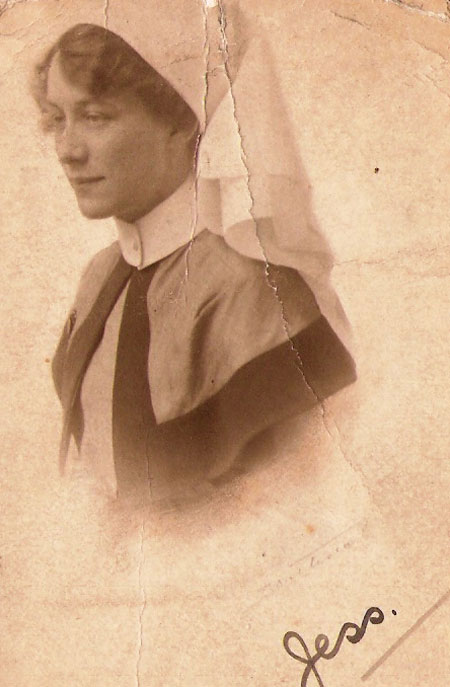
My great-great-aunt (dad's maternal grandmother's sister) Staff Nurse Jessie PALMER was born in 1887 and was already pursuing a career in nursing prior to joining the Territorial Force Nursing Service on the home front in 1914. She nursed military patients in Portsmouth and later at 1st London General Hospital. In the course of her service Jessie contracted tuberculosis, and met her husband Reginald (see below) at the sanatorium at Midhurst while they were both undergoing treatment. Jessie recovered sufficiently to be discharged in 1923, although her condition later worsened again. Nevertheless she would live on until 1972.
Jessie's husband (and therefore my great-great-uncle) Lieutenant Reginald Frank HOWSHIP was a bank clerk in civilian life, born in 1987. Reginald first went to France in October 1916 as a private soldier with the 1/9th Battalion / London Regiment (Queen Victoria's Rifles). He was soon transferred to the 1/12th Battalion of the same regiment and then 13th Battalion / Royal Irish Rifles within the famous 36th (Ulster) Division, now receiving drafts from England since recruitment within Northern Ireland was insufficient to replace its losses on the Somme. Reginald served with this battalion until October 1917, and was therefore presumably present for the Battle of Messines and the Third Battle of Ypres.
He was then accepted for officer training in spite of his very poor eyesight (on his second application) and graduated in April 1918, receiving a territorial commission in the East Surrey Regiment and joining its 12th Battalion (within 41st Division) at the front in Flanders that August. Reginald served with distinction in the final months of the war on this front, subsequently receiving the Military Cross for his "fearless and cool leadership" during the crossing of the Yser Canal at Knokke (south of Courtrai, not to be confused with the seaside resort of the same name) on 22nd October 1918. He met Jessie at the sanatorium at Midhurst, where they were both receiving treatment for tuberculosis. Having survived the war he married her in 1923, but sadly succumbed to T.B. in 1927.
My distant cousin (dad's maternal grandmother's cousin) Rifleman John PALMER was born in Cumberland in 1887, and was working as a draper's assistant in London when he enlisted. He married a Cumberland school teacher on 5th December 1916 and went to France in January 1917 with the 2/5th Battalion / London Regiment (London Rifle Brigade) within 58th (2/1st London) Division. The battalion fought at Bullecourt and in the Third Battle of Ypres. Sadly John was mortally wounded in the fighting for the Menin Road Ridge on 20th September 1917 and died eight days later in hospital at Camiers.
My great-grandfather (dad's paternal grandfather) was medically unfit for service.
My great-great-uncle (dad's paternal grandfather's brother) Gunner Gilbert LUCAS joined the Honourable Artillery Company, the oldest unit in the British Army, in 1917. In addition to its infantry and horse artillery units, it raised a fully mechanised siege battery (numbered 309) armed with 26 cwt 6" howitzers in 1917. This battery was enlarged to three subsections each of two howitzers in February 1918, which is when Gilbert arrived in France as part of its new centre section.
In 1918 309 Siege Battery served mostly under 47th Brigade, Royal Garrison Artillery. It helped stop the German advance on Amiens in late March 1918. When the Allies went over to the attack, it supported the 8th August offensive at Amiens, subsequently serving in the Battle of Bapaume, the pursuit to the Hindenburg Line and the advances beyond. Gilbert served with the battery into 1919, and died in 1962.
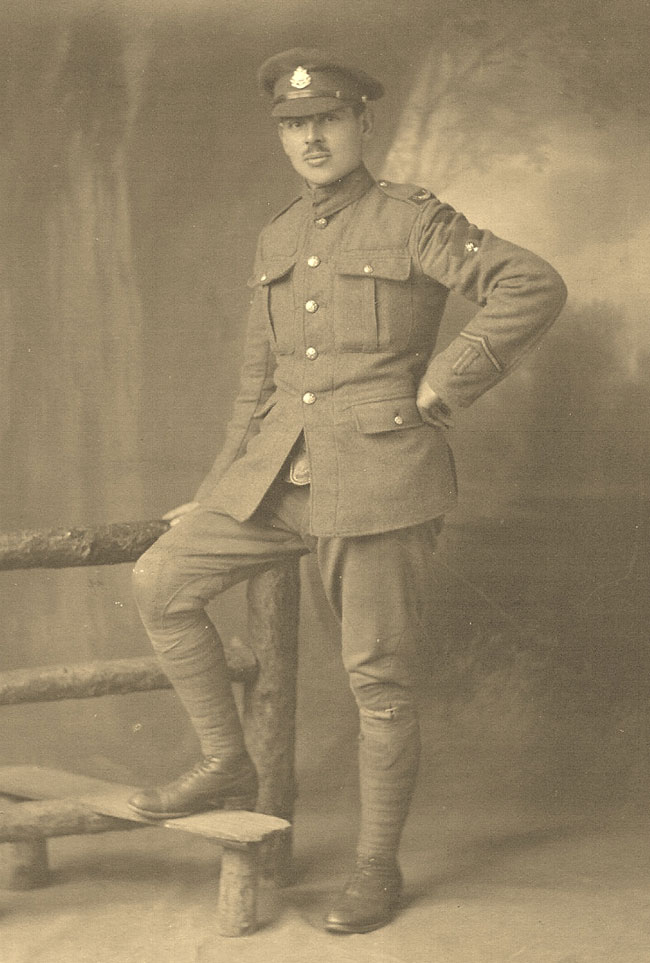
My great-great-uncle (dad's paternal grandmother's brother) Private Charles WOODBURY was born in 1891 and although a married man with a small child, enlisted in June 1915. As described in my father's acclaimed battalion history The Journey's End Battalion, Charlie arrived on the Western Front to join 9th Battalion / East Surrey Regiment within 24th Division in October 1915, while the division was rebuilding following its exceedingly bloody debut at the Battle of Loos. He was wounded in June 1916 (so was not present when his division went to the Somme) and again in June 1917, one of these apparently being a head wound according to his obituary. Nevertheless he made it through both Third Ypres and the Kaiserschlacht of March 1918.
As depicted in fictionalised form by R.C. Sherriff (who was himself no longer with them by that point) the battalion was virtually wiped out while opposing the great German offensive, and Charlie was among those who narrowly escaped captivity by swimming across the Somme river. The battalion and its parent division were both rebuilt and returned to the front by May, joining the British advance near Cambrai in October. Charlie's luck finally ran out at Haussy on October 16th, when the battalion was severely mauled in a German counterattack during which Charlie was captured. By the time he returned to England he was a shadow of his former self, and proceeded to drink himself into an early grave in 1922.
My great-great-uncle (mum's paternal grandfather's elder brother) Sergeant Albert HEMMINGS was born in Bristol late in 1887, and was working in the coal mines of South Wales when he enlisted at Newport. As a result he served with the 6th South Wales Borderers (the divisional pioneer battalion of 25th Division) on the Western Front, arriving in France on 24th September 1915.
As such he is believed to have served on the Somme in 1916, at Messines and 3rd Ypres in 1917 and then against multiple German offensives in spring 1918. Albert was wounded in September 1916, when he was still a corporal. He was killed in action at the village of Ploegsteert during the Lys offensive on 10th April 1918 and has no known grave, leaving behind a wife and four children. Consequently his name is on the Ploegsteert Memorial to the Missing.
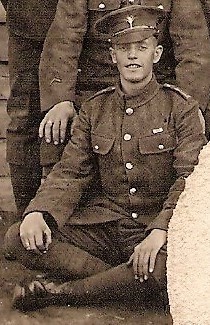
My great-grandfather (mum's paternal grandfather) Private Henry HEMMINGS was a labourer who enlisted in his home town of Bristol with the Welsh Guards on 5th March 1917 at the age of 18 years and 9 months. He arrived in France on 22nd October 1917, in time for the Battle of Cambrai. He continued to serve with the Welsh Guards until 30th November 1919, so was also present for the Kaiserschlacht, Amiens and the final advance to victory.
German
My great-grandfather (mum's maternal grandfather) Kriegsfreiwilliger-Gefreiter Arno BIERAST volunteered in August 1914 and joined 3. Batterie / Kgl. Sächs. 4. Feldartillerie-Regiment Nr. 48 (part of 23. Infanterie-Division / XII. Armeekorps) on the Aisne north of Reims that October. His regiment remained in this front well into 1916, and fought on the Somme that autumn. At the end of the year FAR 48 transferred to the new 241. Infanterie-Division and subsequently spent 1917 on the Eastern Front, where they took part in the defeat of the Kerensky Offensive and the subsequent pursuit of the beaten Russians back to their pre-war border. In 1918 Arno's regiment and division took part in multiple German offensives, before suffering disastrous losses against the French and Americans at Soissons on 18th July. They suffered a second severe mauling north of Saint-Quentin in early October, with the result that FAR 48 would ultimately have the highest losses of any Saxon field artillery unit.
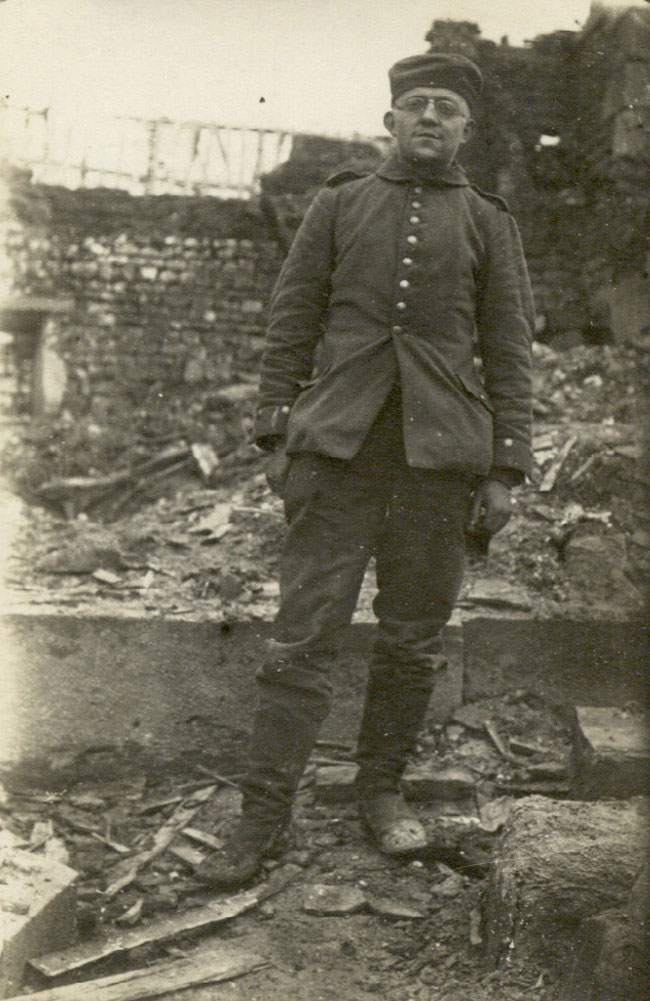
Nevertheless Arno himself came home safely with nothing worse than the hearing damage typically suffered by artillerymen; he was awarded the Iron Cross 2nd class and the Saxon Militär-St. Heinrichs-Medaille in bronze. After the war he established a successful career as a white-collar trade union leader, which led to involvement with the underground conservative opposition from 1934 onwards. According to the post-war founder of the CDU, Arno was intended to serve in the projected Goerdeler government which the July 1944 coup plotters hoped to install. Successfully evading scrutiny by the security services and the horrors of the Battle of Berlin, he ultimately died peacefully in West Berlin in 1956.
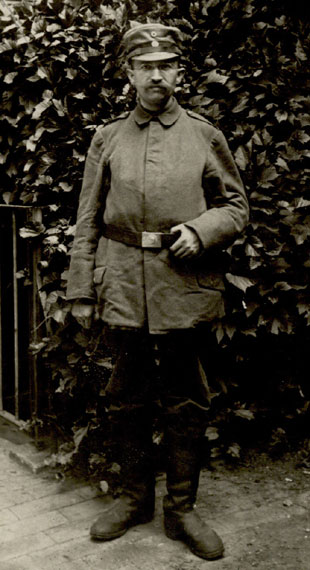
My great-great-uncle (mum's maternal grandfather's brother) Offiziers-Stellvertreter Rudolf BIERAST is known to have served as a platoon commander with 12. Kompagnie / Kgl. Sächs. 5. Infanterie-Regiment 'Kronprinz' Nr. 104 (part of 40. Infanterie-Division) on the Western Front in 1918, and is recorded as lightly wounded. Sadly we do not know how long he had been serving with the regiment prior to this. Rudolf survived the war and (according to my grandmother) subsequently became a teacher. He was still alive at the time of Arno's funeral, and continued to reside in Saxony (so in the DDR).
There are other Bierasts too who are surely related to us, but I do not know exactly how. There is one I am reasonably certain of because of references I remember seeing in a post-war letter from Rudolf where I believe he mentions the "Chemnitzer Bierasts" (this man's birthplace according to the Verlustlisten, where he is noted as wounded in the list of 10th August 1916): Soldat? Karl BIERAST, 11. Kompagnie / Kgl. Sächs. Reserve-Infanterie-Regiment Nr. 104.
My great-great-great-uncle (mum's maternal grandmother's uncle on her mother's side) Landsturmmann Paul FREUND is known to have been serving with 1. Kompagnie / Landsturm-Infanterie-Bataillon Leipzig XIX.3 on the Saxon home front in July 1917. Our evidence here is a single postcard with a photo of Paul in uniform, and we know nothing else about his service or indeed his life. If he remained with this unit for the duration he would not have seen any combat.