DETACHEMENT VON DER DECKEN (from the Douve to the St. Yvon road) was based around 10. Kgl. Sächs. Infanterie-Regiment Nr.134 (minus its II. Bataillon and one two-gun Zug of the MG-Kompagnie). The ad-hoc 'detachment' also controlled a varying number of Jäger battalions and cavalry engineering units left behind by the departing HKK 2 (2nd Cavalry Corps) on the Saxons' right. Field artillery was provided by 40.ID (FAR 32 and FAR 68), with two 7.7cm field gun batteries and a pair of 10.5cm howitzers at Oberst von der Decken's disposal.
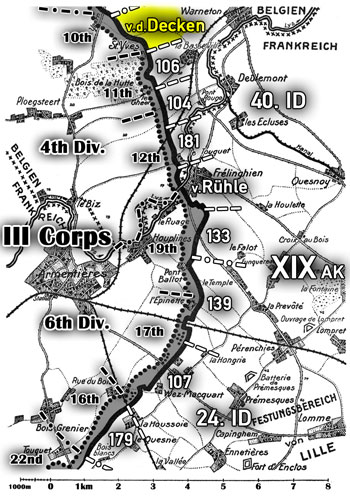
On Christmas Eve the detachment's front was held from north to south by Hannoversches Jäger-Bataillon Nr.10 (JB 10), Kgl. Bayer. 1. Jäger-Bataillon König (bJB 1) and III. / IR 134 - respectively holding Unterabschnitt (subsector) 'A', 'B' and 'C'. This Warneton sector map for 1914-1915 from the published history of JB 13 clearly shows the subsector boundaries, although not the trenches in 'C'; note also the sector's southern boundary at the Yves-Strasse. The Jägers seemingly only had one company per battalion in the line, whereas III. / IR 134 had at least two (probably 10. and 11./134) deployed abreast. This Saxon battalion was supported by the detached MG-Kompagnie of 2. Schlesisches Jäger-Bataillon Nr.6 (MGK / JB 6); the main body of JB 6 was far to the south on the Argonne front). Since the end of November this machine-gun company had been deployed in positions forward of Damier-Ferme, from which it contributed to the defeat of the British attack in the IR 106 sector on 19th December. There is nothing in the published histories of JB 6 and IR 134 to support the contention that MGK / JB 6 was with II. / IR 134 at Frelinghien that Christmas.
Facing Oberst von der Decken's force was 10th Brigade (4th Division) with (from north to south) 2nd Seaforth Highlanders and 2nd Royal Dublin Fusiliers in the front line. The Dubliners would be relieved by 1st Royal Warwicks late on Christmas Eve.
The only known account from the Germans facing the Seaforths is found in the published history of JB 10 (published in 1933) and is surprisingly frank. According to this account, 4. / JB 10 took over the line about 9pm on Christmas Eve and brought their Christmas trees and lights with them. Contrary to claims by the Seaforths to have begun singing first, JB 10 describes the enemy ceasing fire and starting to call out to them in response to the German festivities. Hauptmann der Reserve Richter, the company commander, was alarmed by this development and strongly suspected a ruse. He immediately ordered his men to fire a volley at the enemy, which evidently went well over their heads (surely on purpose). This failed to deter the Scots, and eventually the English-speaking Oberjäger Echte met them at the wire; it is likely that Echte was the English-speaking German described by Corporal John "Fergie" Ferguson of the Seaforths in his famous account.7 From entries in Verlustlisten we can add that Echte's name was Friedrich, he was born at Klein Berkel near Hameln and he was an Einjährig-Freiwilliger (one-year volunteer). Echte was reported in the Prussian Verlustliste published on 1st December 1914 as 'lightly wounded' but still with his unit. He appears again in the list of 19th July 1916, now with 2. Kompagnie and promoted to Vizefeldwebel, and is reported as 'missing' - this is corrected to severely wounded in the list of 15th September 1916. His war quite likely ended at that point.
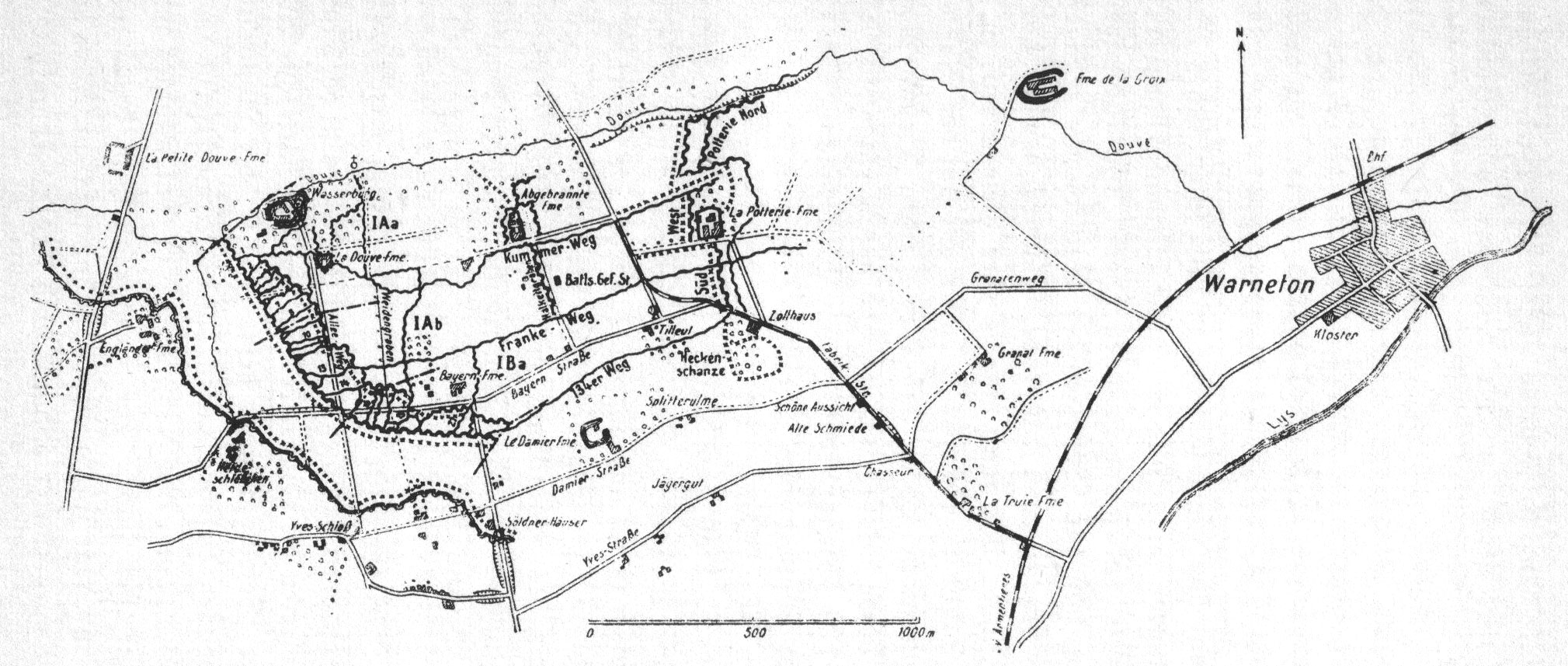
Above: Partial map of the sector of Detachement von der Decken taken from Freiherr von Uslar-Gleichen, Das Kgl. Sächs. 2. Jäger-Bataillon Nr. 13 im Weltkriege.
Surprisingly all British accounts overlook the fact that JB 10 was recruited in Prussian-annexed Hanover, and bore the famous 'GIBRALTAR' cuff title commemorating the Hanoverian defence of that British fortress. In purely geographical terms they were from Niedersachsen (Lower Saxony), the old tribal homeland of the Saxons in northern Germany where much of the Anglo-Saxon migration into England had originated.
On Christmas Day the Hanoverian Jägers engaged in further fraternisation, in conjunction with the burial of the dead (many of whom were French in this sector). Threats of punishments from Hauptmann Richter were personally quashed by the battalion commander. Richter's company was relieved by another of the battalion on Boxing Day. On the night of 28th-29th December JB 10 was relieved by 2. Kgl. Sächs. Jäger-Bataillon Nr.13 and bJB 1 by Kgl. Bayer. 2. Jäger-Bataillon. Meanwhile the Seaforths had been relieved on the 27th by 1st Royal Irish Fusiliers and the Royal Warwicks on the 28th by the Royal Dublin Fusiliers.
Father Ned Dowling (chaplain to the Dublin battalion) describes fraternisation and the exchanging of souvenirs "in these days" without specifying dates. He fondly describes a box of cigars sent as a Liebesgabe from the city of Leipzig, possibly reaching him via IR 106 at Ploegsteert Wood. He also states that a planned football match was "a washout as the guns had orders to fire some rounds"; when this was reported to the Germans, the infantry of both sides joined together in cursing the perceived selfishness of the artillerymen (who surely had no more choice in the matter than they did).
The truce in this area would persist into early January, although (according to JB 13) outright daylight fraternisation was successfully suppressed.
As for the southern half of the British 10th Brigade sector, the aforementioned 2nd Royal Dublin Fusiliers had held it until relieved on the evening of the 24th. As Father Dowling recorded in his diary:
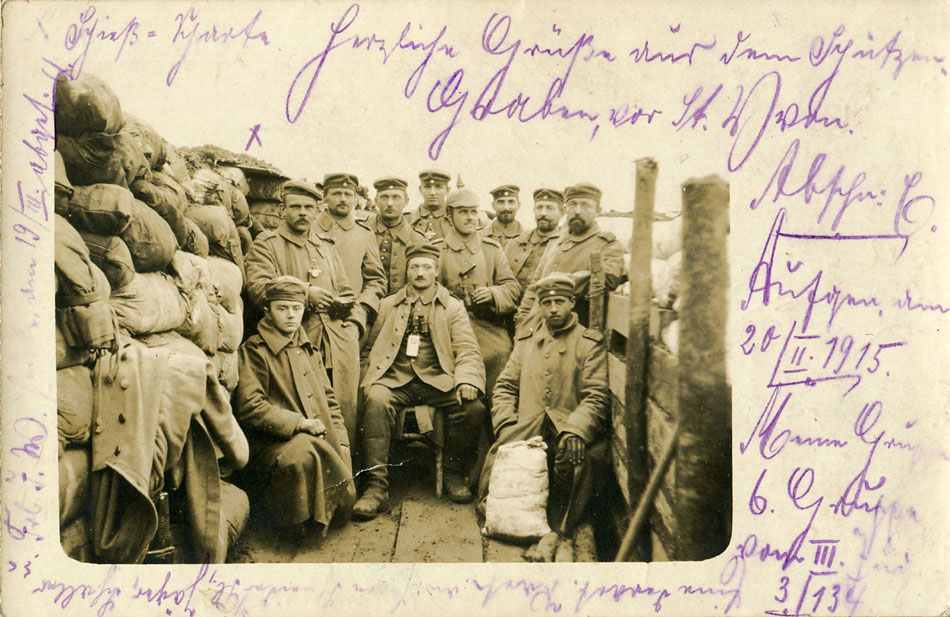
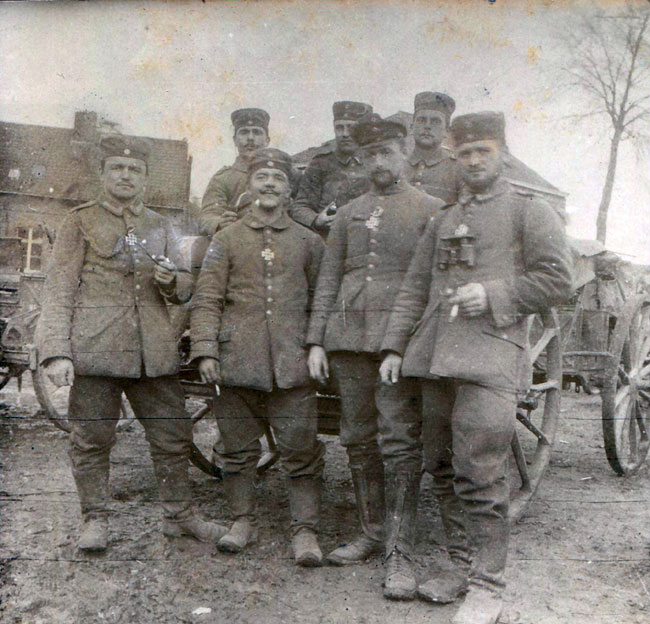
Above: The 6. Gruppe, 3. Zug (6th section, 3rd platoon) of 3. Kompagnie / IR 134 on 20 February 1915 in the trenches near St.Yvon. Another copy of this same photo appears in our first book Fighting the Kaiser's War (p.67), annotated in the same handwriting. The recently discovered copy seen here has more text (including on the reverse) and reveals that the sender was Unteroffizier Max Seidel, who sent it home to his parents in Adorf (Vogtland) from La Basse Ville on 19th March 1915.
On both copies of this photo, Seidel has marked a loophole (Schießscharte) in the parapet with a cross. Note the extensive use of sandbags to build up the line above the level of the water table.
When the Royal Warwicks arrived that evening to conduct the relief, they were informed by the Dubliners that the Germans had expressed a desire for a truce. Lieutenant Henry John Innes Walker (a New Zealander serving in the British Army) described subsequent events in a letter home to his parents on 26th December:
Besides these two exceptions, Walker claims that both sides remained in their trenches, alternately serenading and applauding each other. Like other British eyewitnesses, he mentions the Germans "joining in" with British singing of 'God Save the King' - apparently unaware that the German imperial anthem 'Heil dir im Siegerkranz' has the same melody.
On Christmas morning, Walker observed outright fraternisation ("the most farcical affair") and evidently made no attempt to intervene. Indeed, it can clearly be inferred that he took part himself:
"Many funny things happened. One of our sergeants, a great burly fellow and a real good sort—saw quite a kid walking about. He looked at him and dived into his dug-out and produced a stick of chocolate and gave it to the boy, who was delighted. Later on someone must have been doing a bit of shooting in the wood just behind us and fired his rifle. It almost caused a panic, but when I explained matters they quieted down. Most of them can talk English fairly well. During the morning they had an impromptu soccer match, England v. Germany, with an old cap, which ended in one of the Germans being pushed into their own barbwire entanglements and getting rather cut about."
This bombardment of La Basse-Ville, which claimed numerous victims, showed that the tacit ceasefire in this period did not apply to the artillery. His missing shoulderstraps possibly indicate that Zehmisch had only recently received his reserve officer’s commission and not yet updated his uniform; without access to the full diary I am unable to verify this theory.
In my opinion, this unusually specific and plausibly detailed reference to a football match has the ring of truth - and is partially collaborated by the account of Leutnant der Reserve Zehmisch of IR 134. Walker also frankly recorded how the company officers on both sides subsequently conspired to put the truce on a more orderly and militarily acceptable footing. Sadly he does not name his Saxon counterpart.
There is clearly no doubt that the Warwicks fraternised with IR 134, and perhaps also with bJB 1. However the published history of IR 134 (published in 1922) states only that Christmas passed 'peacefully' and that of bJB 1 does not mention it at all. Fortunately a fine unpublished source survives at the In Flanders Fields Museum in Ypres - the private diary of Leutnant der Reserve Kurt Zehmisch, a platoon commander with the 11. Kompagnie / IR 134. Apparently a teacher of languages in civilian life, Zehmisch was fluent in both English and French.
In his diary Zehmisch states that his company set out at 6pm (7pm British time) to relieve 1. Kompagnie in the line. He had already ordered his men not to fire on Christmas Eve or Christmas Day if it could possibly be avoided. They immediately set about contacting the enemy, initially by whistling. Zehmisch and the likewise English-speaking Soldat Möckel then engaged them in conversation across No Man's Land. Eventually two Tommies met Möckel and his comrade Muß at the wire, where they chatted and traded British cigarettes and tobacco for German cigars. Both sides refer to this approach making use of the cover of a 'hedgerow' or 'ditch', possibly indicating the part of the current Chemin du Mont de la Hutte (Damier-Straße) which ran across No Man's Land north of St. Yvon. Zehmisch makes no mention of British envoys actually visiting the German trenches as described (second-hand) by Walker, or of the Germans deliberately illuminating themselves; instead he makes a point of noting that it was a very clear moonlit night. Oddly Zehmisch only describes singing and the display of trees and candles after this initial fraternisation. Somewhat later he too went out into No Man's Land with Muß to converse with the British from a distance.
In his entry for Christmas Day, Zehmisch mentions that Abschnitt 'A' on their right (JB 10) had been informed of the prior fraternisation by telephone and subsequently established contact with the British themselves. Since we know that JB 10 had already done so on Christmas Eve, he may mean the Bavarians (actually in 'B') for whom we have no personal accounts. In his own sector, both sides met in No Man's Land that morning. Conversing in English, French and German the officers soon agreed and organised the recovery and burial of the dead. Most interestingly, he states that an Unteroffizier Holland took three group photos with both sides together; sadly we have not yet seen any such photos of German origin. He also mentions an informal football match in No Man's Land, though unlike Walker he describes use of a real ball (provided by the British) and does not refer to any players being caught in the wire. According to Zehmisch, British officers enquired that evening about the possibility of a formal match between the lines on Boxing Day. With regret he had to tell them that his company would be relieved that evening, and he could make no guarantees about the attitude of the commander of the incoming 1. Kompagnie.