The famous Christmas Truce of 1914 is the one major event of the war where the presence of the Royal Saxon Army has become deeply embedded in British cultural memory. Indeed, so far as we know, the Sainsbury's Christmas advertisement of 2014 was the first cinematic portrayal of Saxon troops of the Great War (wearing the Saxon cockade and the insignia of IR 104, albeit with Prussian tunics) to appear in the English-speaking world!
Given the extensive literature of this subject, readers might well imagine that there is nothing more to be said. However we believe that by close comparison of the sources from both sides (including some Saxon sources overlooked by or unknown to other writers in English) and an emphasis on locating the units involved on the map, we have made a meaningful contribution to the existing scholarship.
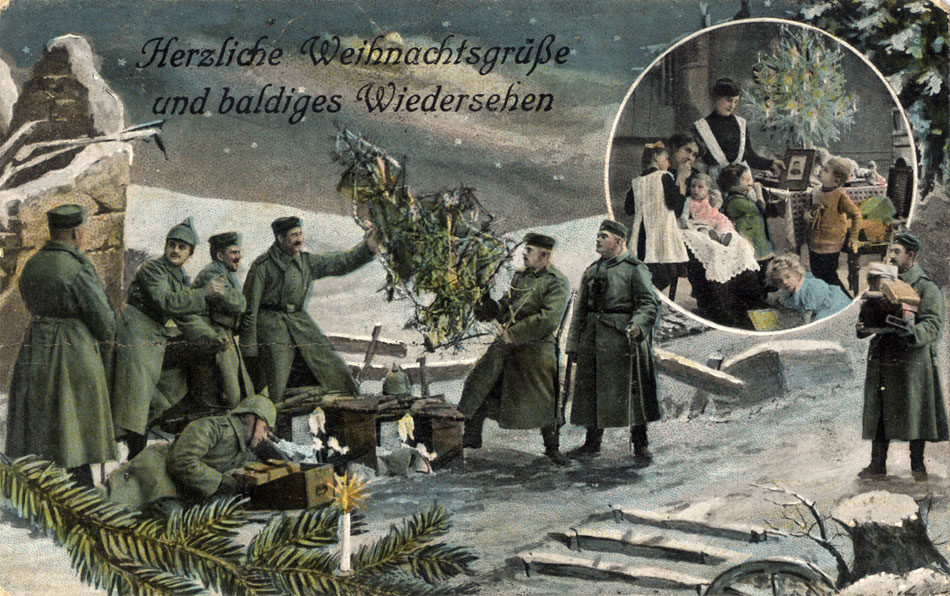
Above: A typical sentimental Christmas card from 1914, expressing a sadly vain hope for a swift reunion with families at home.
This article is the latest revision of a piece which first appeared on the centenary in December 2014. Since then it has been updated and expanded repeatedly, now incorporating several additional sources (from both sides) which have subsequently been brought to our attention. Thanks are due to my father (and fellow published WW1 author!) Michael Lucas, to Simon Verdegem, my esteemed co-author Jürgen Schmieschek and others (whose names I quite unforgivably have forgotten) for bringing my attention to some of these new sources.
In Fighting the Kaiser's War we only had limited space to outline the events of the 1914 Christmas Truce on the front of XIX. Armeekorps, the only Saxon formation to be facing the British at the time. For King and Kaiser provides a great deal more detail on the northern (40. Infanterie-Division) half of this front, but still touches only fairly lightly on the fascinating subject of the Truce. In this article, I attempt to pin down the locations of all of the known accounts from this front, showing which British units faced which German ones and how the sources match up.
Temporary tacit ceasefires also occurred with the French on the front held by the Saxon / Württemberg XXVII. Reservekorps north of the Menin Road, and one French source describes a brief episode of fraternisation on the northern part of that front earlier in December. However the prolonged trucing and mass fraternisation that took place at Christmas 1914 between the troops of XIX. Armeekorps and their opponents were not replicated in any other Saxon sector. As noted above, no other Saxon formation was facing the British.
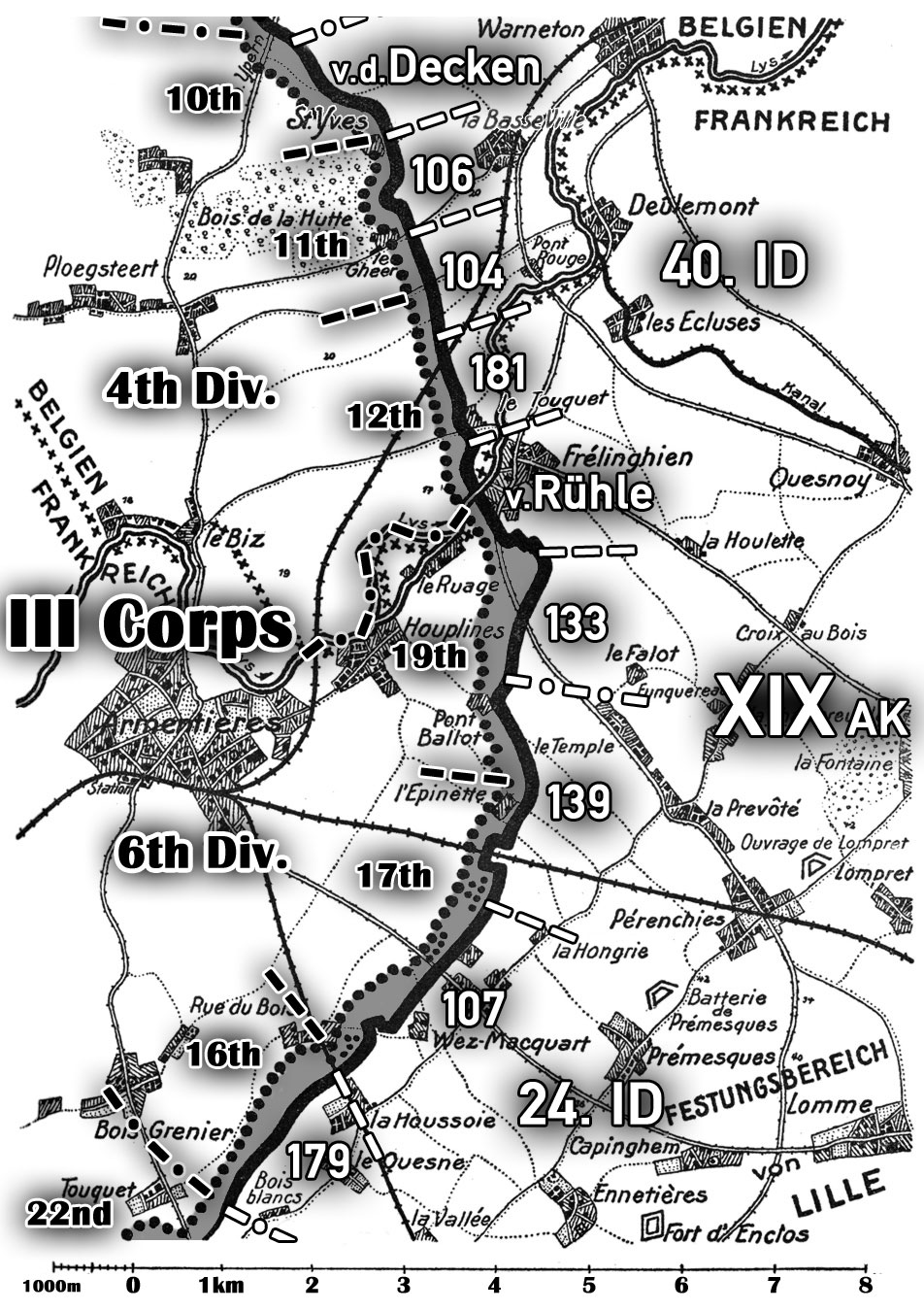
In December 1914, XIX.AK was holding the front from the Douve in the north to the vicinity of Bois Grenier in the south, with 24.Infanterie-Division on the left and 40.Infanterie-Division on the right. Divisions, brigades and even individual regiments were all somewhat dislocated and intermingled due to the manner in which reserves had been fed into the battle that October and November. This would not be resolved until the beginning of March 1915, in conjunction with the reorganisation of each division with only three rather than four infantry regiments. IR 106, IR 107 and their parent brigade HQ were then donated to the new 58.ID, and IR 133 transferred from 40. to 24.ID.
On the extreme right flank between the Douve and Ploegsteert Wood, several battalions of Bavarian and Prussian Jägers plus support units had been inherited from the army cavalry previously deployed alongside XIX.AK. These were all attached to 40.ID as part of a composite 'Detachement von der Decken' commanded by the staff of IR 134. As far as we could determine from the available German sources, the remainder of the corps front was held exclusively by its own organic Saxon units. Trucing and/or fraternisation occurred along most of this frontage, including all of the non-Saxon units and most of the Saxon ones. Most XIX.AK officers at all levels appear to have welcomed these developments, and to have been concerned chiefly with putting truces onto a justifiably official basis, preserving a degree of discipline and keeping up appearances against the possible adverse reactions of their superiors. Wherever possible, truces were exploited productively by both sides to allow for the retrieval and burial of the dead (something which both sides considered as legitimate military justification for a truce) and to get other work done more easily and comfortably in the open.
It is important to note that extensive trucing and fraternisation also occurred both to the north and to the south of the Saxon corps. To the right / north of XIX.AK was 6.bRD (6th Bavarian Reserve Division), with the Prussian 11. Landwehr-Infanterie-Brigade (LIR 20 left and LIR 35 right) attached on its left flank south of Messines. The presence of these Prussian regiments has been seemingly overlooked by all previous authors, and only became apparent to me upon cross-referencing the personal account of the celebrated scientist Otto Hahn (then serving as machine-gun officer with a unit I managed to identify as LIR 20) with regimental histories from the Bavarian division. LIR 20 was raised at Wittenberg and LIR 35 in Brandenburg, making at least the latter indisputably Prussian in every sense of the word. Sadly LIR 20 has no published history and that of LIR 35 is not readily available. Nevertheless both Hahn's and several British accounts suggest that at least some men of this brigade took part in the trucing and fraternisation, as did the Bavarian regiments on their right (bRIR 16 and 17, both of which produced eyewitness accounts of the truce).
To the left / south of XIX.AK were the Westphalians of Prussian VII.AK (comprising 13.ID on the right and 14.ID on the left). Many units of this corps fraternised just as enthusiastically as the Saxons, and are - most intriguingly - often misidentified as 'Saxons' in British reports. The consistency of this mistake in numerous reports by British eyewitnesses seems to imply that this was not merely a misunderstanding on their part, but rather a deliberate deception on the part of Westphalians who had seemingly chosen to present themselves to the enemy as Saxons - strongly suggesting that they believed that they would be more kindly received as such.
It is evident from passing references in British accounts prior to Christmas 1914 that the Saxons already had a good reputation with the enemy, based presumably on pre-war associations and on incidents earlier in the campaign - for instance the ceasefire for recovery of the wounded between 2nd Leinsters and IR 179 at Prémesques on 20 October. Seemingly due to this existing reputation, some non-trucing Saxons were misidentified at Christmas 1914 due to what the British took to be their 'un-Saxon' behaviour. At Rue du Bois Major Buchanan-Dunlop of 1st Leicestershires (16th Brigade / 6th Division) was facing both IR 107 and IR 179 of 24.ID - he correctly identified the former, fraternising regiment as Saxons ("jolly cheery fellows for the most part, and it seems so silly in the circumstances to be fighting them") but misidentified the less friendly IR 179 as Prussians ("very vicious indeed"). British press coverage would subsequently emphasise the Saxon desire for peace and openly attempt to sow disunity between Saxony and Prussia, to the great professional embarrassment and annoyance of the officers of XIX.AK. Having written approvingly in his diary of the truce at the time, Generalmajor Kaden of 48. Infanterie-Brigade reacted furiously to British newspaper stories on 8th January:
Verbal contact between the opposing sides was established in most cases on Christmas Eve, following the display of Christmas trees and lights in the German trenches and the massed singing which accompanied it. As many British readers will know, German celebrations traditionally emphasise Christmas Eve.
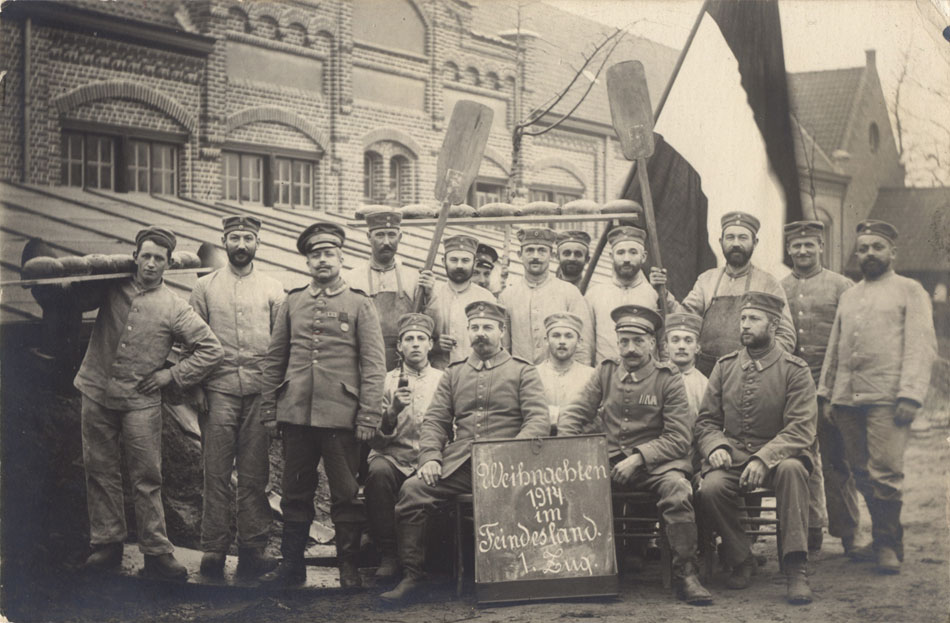
Above: NCOs and men from the 1. Zug (1st section) of Feldbäckerei-Kolonne XIX.1 at Christmas 1914, somewhere in the corps rear area (probably in the western suburbs of Lille). In addition to rear-echelon units such as this, reserve elements of the fighting units also got to spend Christmas well behind the front. Artillerymen celebrated either in their gun and limber positions or in their reserve billets.
Feldbäckerei-Kolonne XIX.1 was one of the two corps bakery columns, which used their enormous horse-drawn ovens to keep XIX. Armeekorps supplied with bread in the field. The huge wooden 'oars' were used to retrieve the loaves from the oven.
Note that the massed Christmas trees displayed by the Germans were by no means the result of unofficial or spontaneous action. An order of the day dated 11th December 1914 from XXVII. Reservekorps indicates that there was an organised operation by Etappen-Inspektion 4 (the rear-area logistical command operating behind 4. Armee in Flanders) to provide the troops with Christmas trees through the same channels as regular military supplies; by implication, the intention was partly to prevent disorderly wholesale plundering of pine trees in the rear areas by the troops. It seems highly probable that Etappen-Inspektion 6 (operating behind 6. Armee, to which XIX. Armeekorps belonged at this time) followed a similar policy.
It is difficult to reconstruct exactly how the Christmas Eve festivities escalated to fraternisation in any given sector, since most available accounts from both sides are keen to assert that the enemy was the first to leave their trenches and the first to offer a truce. Most of the officers and men involved seem to have correctly surmised that the wrath of higher command was far more likely to descend on those who had initiated fraternisation and trucing, than on those who had merely humanely accepted such an offer from the enemy. On the German side, a strict anti-fraternisation order would be issued by OHL (imperial supreme command) on 29th December, proclaiming that all unauthorised approaches to the enemy were to be punished as high treason. As a result, it became essential to put all local truces on a formal basis and to justify retrospectively within that framework any contacts which had already occurred. The most interesting result of this was a handwritten document presented to officers of 1st Rifle Brigade (11th Brigade / 4th Division) at Ploegsteert Wood and preserved in their battalion war diary. Signed by Oberst William Kohl of IR 106 and authorised by "das zuständige Generalkommando" (meaning the corps staff - Generalkommando - of XIX.AK) it proposes an official truce over the New Year period in Kohl's regimental sector for the specific - and militarily justifiable - purpose of recovering the remaining dead of both sides from No Man's Land for burial. Unfortunately, the British were unable to meet Kohl's conditions in time, and this agreement never came into force.
Following the OHL order, some punishments were inevitably imposed on individuals subsequently caught openly flouting the rules on permissible contact with the enemy. Contrary to legend, these punishments were neither widespread nor serious. For instance, when JB 10 was relieved by Saxon JB 13 just south of the Douve on 29 December, the latter unit found an unofficial truce in force and soon had to enforce the OHL order on its men:
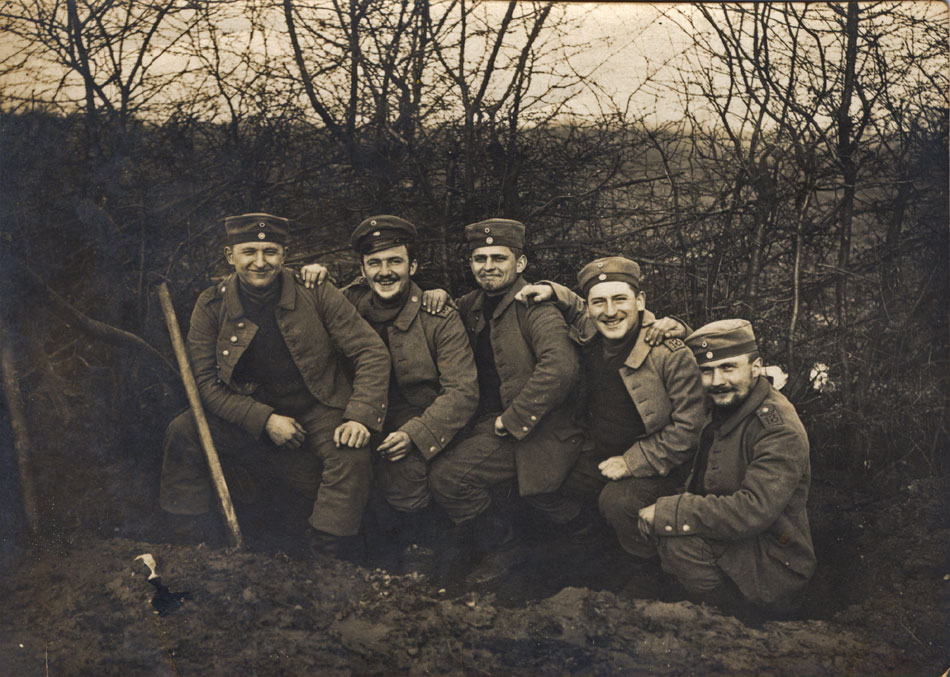
Above: Working party from JB 13 in the rear of the Warneton sector in January 1915. The Gefreiter (lance-corporal / PFC) in charge is presumptuously wearing a peaked Schirmmütze, available for private purchase by any soldier but usually reserved by regulation for NCOs and officers in the field.
One recent discovery which should briefly be noted here is the diary of Divisionspfarrer Ziesch, the Roman Catholic divisional chaplain of 40.ID (held at the Sorbische Institut / Serbski institut in Bautzen). Although dry and repetitive, it reveals the program of Christmas church services which were held in the 40.ID sector. We now know that the following mixed (Catholic and Protestant) services were held behind the front on Christmas Eve:
4.00 pm Verlinghem (Protestant Feldgeistliche Fleischer)
4.00 pm Wambrechies (Catholic Divisionspfarrer Ziesch)
5.00 pm Verlinghem (Catholic Feldgeistliche Plewka)
6.00 pm Quesnoy-sur-Deûle (Protestant Divisionspfarrer Pause)
7.00 pm St. André (Catholic Feldgeistliche Plewka)
In addition, printed orders of service were distributed for use by the troops in the trenches. These were presumably used (at least at first) for the singing which initiated the events of the truce on Christmas Eve. Naturally, we would be exceptionally interested to see any surviving copy of this order of service!
The following services were held on Christmas Day:
9.30 am Quesnoy-sur-Deûle: high mass and sermon (Ziesch)
8.00 am Wambrechies: mass and sermon (unidentified Bavarian chaplain)
10.15 am Verlinghem: mass and sermon (Plewka)
Another undated entry then follows on a new line; since the 26th December is missing in the journal, this presumably refers to Ziesch's activities on that day. This entry states that he held confession and mass in Quesnoy that morning, followed by a hospital visit. That evening he visited I. Bataillon / IR 181 in the trenches and held a Christmas celebration for 6. Kompagnie / IR 134 in Frelinghien, "200 metres from the enemy". Ziesch would therefore surely have become aware of the fraternisation, although IR 181 is not believed to have participated. Frustratingly, he makes no comment on these events in his extremely sparse and businesslike diary.
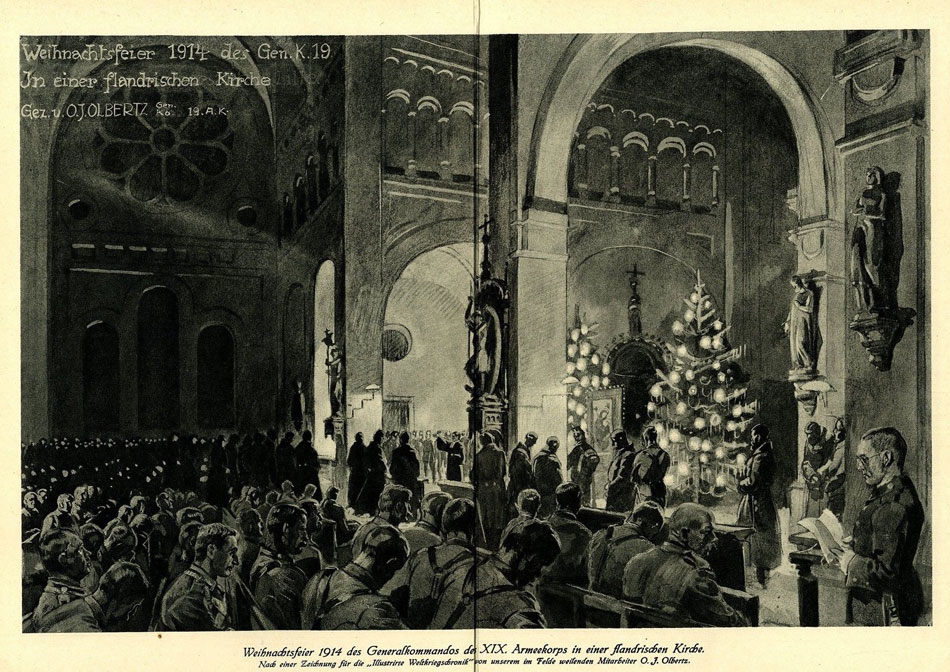
Above: Christmas service for the personnel of Generalkommando XIX. Armeekorps (XIX.AK corps HQ), as depicted by the artist O.J. Olbertz for the 'Illustrirte Weltkriegschronik'. The actual location behind the Armentières front has been censored, but it has now been identified as Lambersart church.
Among the men closest to our viewpoint are a group of cavalrymen (recognisable by their cavalry-issue 'Y-straps'), possibly from the Kavallerie-Stabswache (corps HQ cavalry guards). Also identifiable behind them is an NCO of the Feldgendarmerietrupp des XIX.AK (corps military police) with his distinctive duty gorget on a chain around his neck.
As in Fighting the Kaiser's War (but at much greater length) I will now attempt to summarise events in each Saxon regimental sector in turn, indicating when and where the various well-known personal accounts fit into the story. For the sake of space I have avoided quoting such accounts directly. They can most readily be found in Brown & Seaton's much-reprinted Christmas Truce, to which I will direct the reader with page references in the footnotes.