
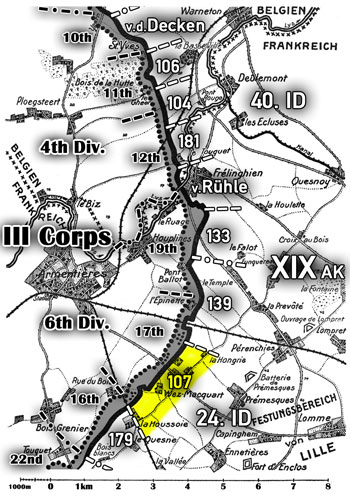
8. KGL. SÄCHS. INFANTERIE-REGIMENT 'PRINZ JOHANN GEORG' NR.107 (from La Bleue / La Hongrie to the railway line at Rue du Bois) had all three battalions in line - from north to south III. / IR 107 (holding Wez-Macquart), II. / IR 107 (holding Epheu-Ferme) and I. / IR 107 (facing Rue du Bois). They may have been partly facing the 3rd Rifle Brigade, and were certainly facing the 1/16th Londons (Queen's Westminster Rifles) and 1st North Staffordshires, likewise of 17th Brigade. On the left I. / 107 also partly faced 1st Leicesters of 16th Brigade. All of these units are known to have fraternised with the Saxons.
It was this sector where the most extensive and prolonged fraternisation occurred. Paradoxically, according to its regimental history (published in 1928), IR 107 was actually on high alert immediately prior to Christmas, in the expectation that the British might take advantage of the celebrations to launch a surprise attack at the existing flashpoint of Rue du Bois, scene of previous heavy fighting in mid-November. Since then the regiment had been menaced only by artillery fire and miserable weather, but had nevertheless been repeatedly alerted in expectation of a British assault. It had also enhanced its own ability to harass the enemy with the issue of the first six optically sighted rifles to its regimental snipers on 12 December.
At 1am on 24 December a demolition team of Saxon Pioniere blew up a house directly in front of the German lines on the Rue du Bois itself (the main road through the village of the same name) to clear the field of fire. Nevertheless the afternoon and evening proved peaceful. According to numerous British sources, the Tommies responded enthusiastically to the regiment's songs and decorations, and soon both sides were out on their respective parapets singing and calling to each other; incidents of fraternisation naturally followed. In a letter to his wife Captain R.J. Armes of 1st North Staffordshires later described how he met a Saxon officer in No Man's Land to agree terms for a burial truce; Generalmajor Kaden identifies this officer as Leutnant Horst von Gehe (subsequently killed in action as a fighter pilot with Kampfstaffel 26 at Mercy le Bas on 17 March 1916).
Both sources agree on the terms of the truce, which was to extend until midnight British time (1am German time) on the night of 25-26 December. The regimental history covers these events in distinctly guarded and defensive terms, omitting any hint of fraternisation. It describes an initial approach to I. / IR 107 at Rue du Bois by a British officer with a white flag to negotiate a formal truce for the burial of the dead. The resulting truce agreement is explicitly stated to have been authorised on the Saxon side at battalion and regimental level.
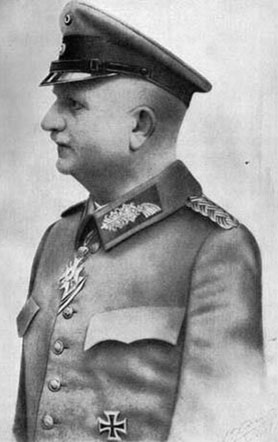
Generalmajor Kaden also adds that the truce decreed that neither side was to enter the other's lines. At the other end of the regimental sector however, first four, then a further two drunken Tommies stumbled into the lines of III. / IR 107 (Wez-Macquart - La Bleue) that night and were taken prisoner; these are believed to correspond to three men of the Queen's Westminster Rifles (Privates Noel Byng, Herbert Goude and Pearce) and three of the 3rd Rifles (Lance-Corporal Carpenter and Privates Buckley and Latimer), all of whom 'went missing' on Christmas Eve and were later reported captured. The Casualty Book of the Queen's Westminster Rifles records the loss of Byng, Goude and Pierce as missing and confirmed captured with the following rather sheepish note:
Kaden describes two of these men in his diary, and claims that they took part (as 'Krampus') in the regimental distribution of gifts behind the lines that same night!
According to the regimental history, contact with the enemy on Christmas Day was limited to a formal burial truce between I. / IR 107 and their opponents at Rue du Bois (beginning promptly at 9am); movement on both sides is stated to have been strictly limited by marked lines. The fighting in this area had been extremely bloody, especially on 28 October when IR 107 briefly took the town but was too weakened by losses to hold it. With the aid of the enemy, many of the dead were successfully identified and given a proper burial that Christmas. These included Oberleutnant Mehlig of 8./107 and Vizefeldwebel Kühn of 2./107, both said to have been killed in the assault on the 28th.
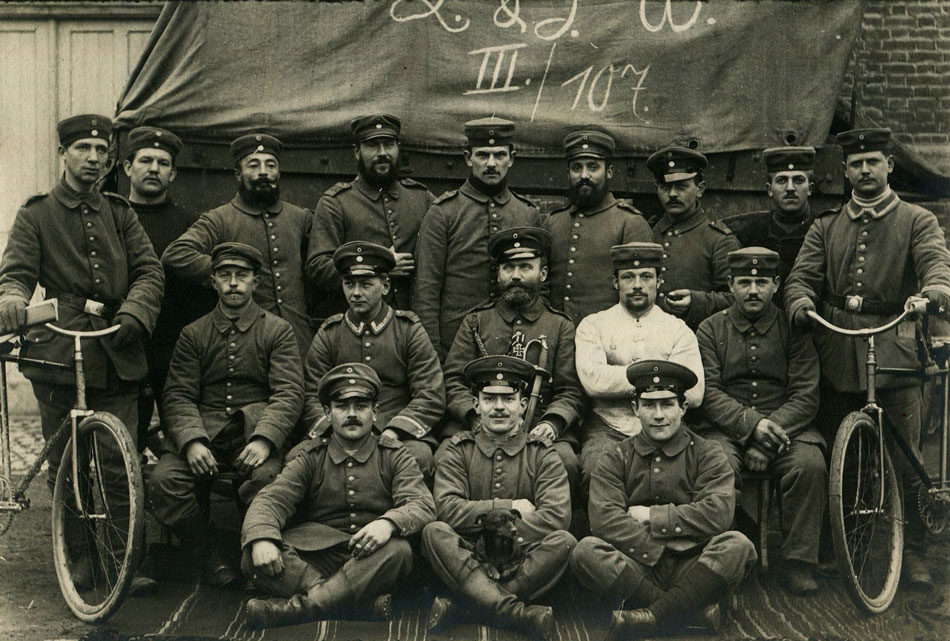
Above: Personnel from the baggage echelon of III. Bataillon / IR 107 pictured in front of one of their horse-drawn vehicles in January 1915. Interestingly both of the Radfahrer (cyclist messengers) have the same model of bicycle as the cyclist from this regiment whose photo (dated February 1915) appears on p.45 of Fighting the Kaiser's War, although all are still in their glossy civilian paint job beneath the dirt. Note the extremely early sighting here of a pair of (probably home-made) puttees on the man seated furthest right. Also visible on close inspection is the unique pattern of belt buckle worn only by this regiment, featuring the cypher of their patron Prince Johann Georg of Saxony (the king’s younger brother).
The regimental history of IR 107 is entirely silent on the ensuing fraternisation described by numerous British witnesses as developing all along its regimental front, and taking increasingly curious forms; many of the most colourful British stories of the Christmas Truce originated here.41 Officers and men wandered about freely in numbers too large to be controlled by the authorities on either side. Rather unsportingly, Major Arbuthnot of 24 Battery Royal Field Artillery took the opportunity to reconnoitre Wez-Macquart and identify future targets while disguised as a German.
The truce was officially ended by the British firing four small shells at the agreed hour. However this was clearly no more than a symbolic gesture. A regimental order for IR 107 to resume hostilities at midday on Boxing Day was courteously passed on to 1st North Staffordshires by a junior officer, and resulted only in a brief and harmless token volley. While normality (albeit somewhat subdued) was restored along the rest of the regimental front, the unofficial truce at Rue du Bois persisted as a fait accompli and was pragmatically exploited by IR 107 to get as much work as possible done on the trenches in the open. Nevertheless it must have been an uncomfortable situation for the regimental staff following the dissemination of the OHL anti-fraternisation order. Numerous British anecdotes indicate that fraternisation and even visits to the British trenches (in numbers too great for those involved to be taken prisoner) had not ended. Every level of German military authority would certainly have been horrified had they known that HRH Prince Ernst Heinrich of Saxony (the youngest of the King's three sons) and a fellow staff officer had been among those visitors. The prince's autobiography does not state when or if he ever described this memorably unorthodox experience to his royal father or brothers.
The Queen's Westminster Rifles were relieved by 1st Royal Fusiliers on Boxing Day, and rejoined 18th Brigade.